The Goal of This Post
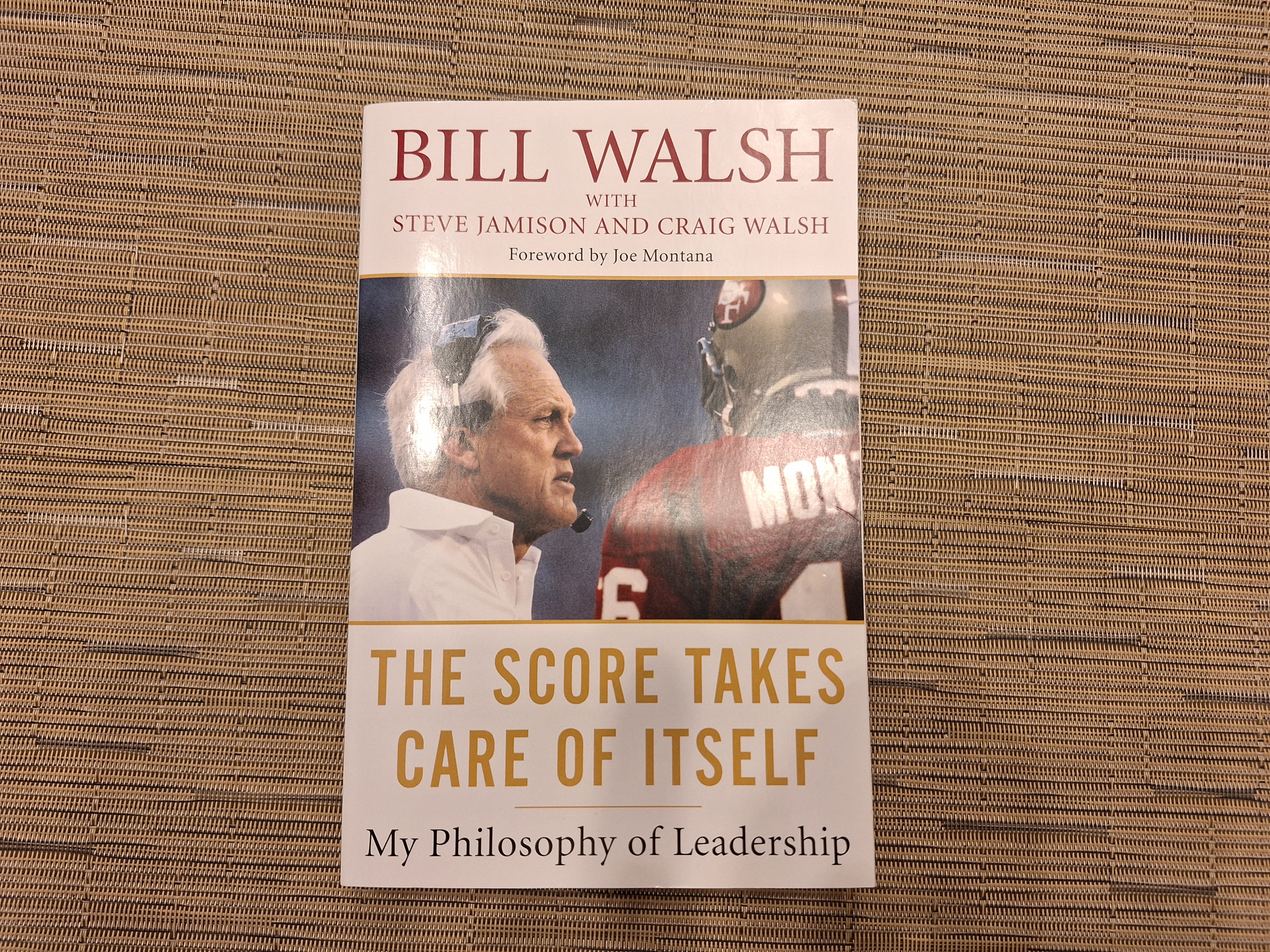
This post is a synthesis from the book The Score Takes Care of Itself, by Bill Walsh.
The author shares his story of defining and implementing his Standards for Performance, cultivating and environment of excellence; and leading the San Francisco 49ers to a period of greatness.
If You Only Takeway One Thing
“The ability to help the people around me self-actualize their goals underlines the single aspect of my abilities and the label that I value most—teacher.”
—
1. Standards of Performance
“I came to the San Francisco 49ers with an overriding priority and specific goal—to implement what I call the Standard of Performance. It was a way of doing things, a leadership philosophy that has as much to do with core values, principles, and ideals as with blocking, tackling, and passing.
It began with this fundamental leadership assertion: Regardless of your specific job, it is vital to our team that you do that job at the highest possible level in all its various aspects, both mental and physical.”
—
2. Organizational Conscience
Great teams in business, in sports, or elsewhere have a conscience. At its best, an organization—your team—bespeaks values and a way of doing things that emanate from a source; that source is you—the leader. Thus, the dictates of your personal beliefs should ultimately become characteristics of your team.
You must know what needs to be done and possess the capabilities and conviction to get it done.
—
3. Continuous Improvement
I directed our focus less to the prize of victory than to the process of improving—obsessing, perhaps, about the quality of our execution and the content of our thinking; that is, our actions and attitude.
Concentrate on what will produce results rather than on the results, the process rather than the prize.
—
4. On Fostering Connection
Bonding within the organization takes place as one individual and then another steps up and raises his or her level of commitment, sacrifice, and performance. They demand and expect a lot of one another.
The leader’s job is to facilitate a battlefield-like sense of camaraderie among his or her personnel, an environment for people to find a way to bond together, to care about one another and the work they do, to feel the connection and extension so necessary for great results.
—
5. On a Winning Mindset
The culture precedes positive results. It doesn’t get tacked on as an afterthought on your way to the victory stand. Champions behave like champions before they’re champions; they have a winning standard of performance before they are winners.
—
6. On Character
In building and maintaining your organization, place a premium on those who exhibit great desire to keep pushing themselves to higher and higher performance and production levels, who seek to go beyond the highest standards that you, the leader, set. The employee who gets to work early, stays late, fights through illness and personal problems is the one to keep your eye on for greater responsibilities.
You go nowhere without character. Character is essential to individuals, and their cumulative character is the backbone of your winning team.
—
7. On Preparation
By analyzing, planning, and rehearsing in advance you can make a rational decision, the best choice for the situation at hand. And that still leaves room for those gut-instinct decisions you may want to make.
In the face of massive and often conflicting pressures, an organization must be resolute in its vision of the future and the contingent plans to get where it wants to go.
—
8. On Determination
The leader who will not be denied, who has expertise coupled with strength of will, is going to prevail.
Some leaders are volatile, some voluble; some stoic, others exuberant; but all successful leaders know where we want to go, figure out a way we believe will get the organization there (after careful consideration of relevant available information), and then move forward with absolute determination.
—
9. On Communication
Quality collaboration is only possible in the presence of quality communication; that is, the free-flowing and robust exchange of information, ideas, and opinions.
It’s not just being able to talk back and forth. It’s recognizing when to say it, how to say it, when to listen, whom you’re talking with, how they feel, what you’re trying to get down to, how important the circumstance is, what the necessity is timewise, and how rapidly the decision must be made.
—
10. On Nurturing Self-Belief
The fundamental and underlying message must always be the same: “I believe in you. I know you can do the job.”
As a leader you must have the strength to let talented members of your organization know you believe in them—nurture their belief in themselves, teach them what they need to know, and then watch what happens.
The Way Forward. Cultivate Greatness.
“Your effort in the beginning is part of a continuum of effort; your Standard of Performance is part of a continuum of standards. Today’s effort becomes tomorrow’s result. The quality of those efforts becomes the quality of your work. One day is connected to the following day and the following month to the succeeding years.
Your own Standard of Performance becomes who and what you are. You and your organization achieve greatness.”
All content credit goes to the author. I’ve shared the bits I’ve enjoyed the most and found most useful.
Cheers ’till next time! Saludos!
Alberto


 Beto's Blog