The Goal of This Post
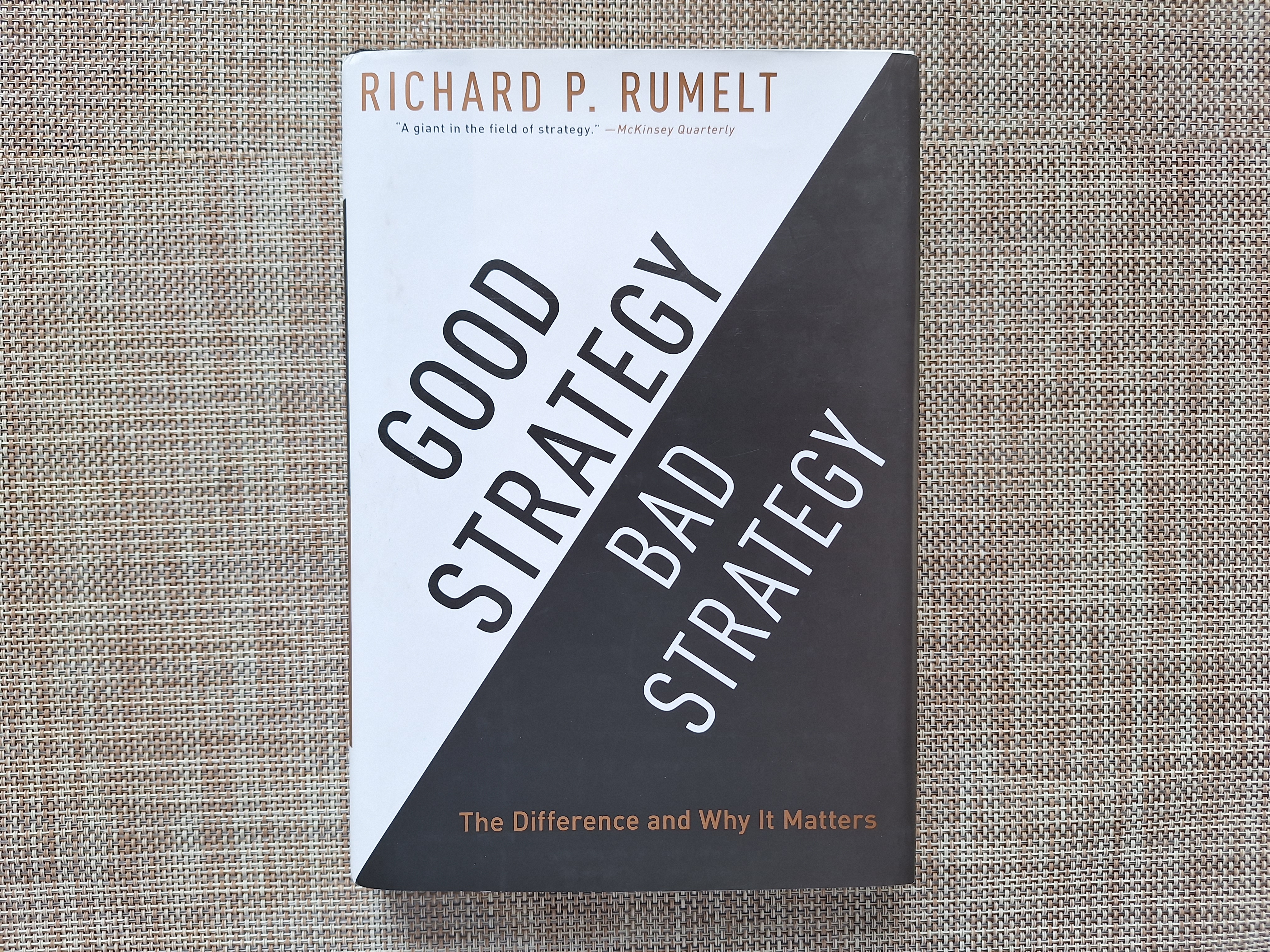
This post is a synthesis from the book Good Strategy Bad Strategy, by Richard P. Rumelt.
The author shares a perspective-changing approach to defining challenges and turning strategic insight into a set of coordinated and coherent actions.
If You Only Takeway One Thing
“The core content of strategy is a diagnosis of the situation at hand, the creation or identification of a guiding policy for dealing with the critical difficulties, and a set of coherent actions.”
—
1. The Kernel of Strategy
“A good strategy has an essential logical structure that I call the kernel. The kernel of a strategy contains three elements: a diagnosis, a guiding policy, and coherent action. The guiding policy specifies the approach to dealing with obstacles called out in the diagnosis. It is like a signpost, marking the direction forward but not defining the details of the trip. Coherent actions are feasible coordinated policies, resource commitments, and actions designed to carry out the guiding policy.”
The kernel of a strategy contains three elements:
- A diagnosis that defines or explains the nature of the challenge.
A good diagnosis simplifies the often overwhelming complexity of reality by identifying certain aspects of the situation as critical.
- A guiding policy for dealing with the challenge.
This is an overall approach chosen to cope with or overcome the obstacles identified in the diagnosis.
- A set of coherent actions that are designed to carry out the guiding policy.
These are steps that are coordinated with one another to work together in accomplishing the guiding policy.
The Diagnosis
“A great deal of strategy work is trying to figure out what is going on.”
- “A diagnosis names or classifies the situation, linking facts into patterns and suggesting that more attention be paid to some issues and less to others.”
- “When a diagnosis classifies the situation as a certain type, it opens access to knowledge about how analogous situations were handled in the past.”
The Guiding Policy
“The guiding policy outlines an overall approach for overcoming the obstacles highlighted by the diagnosis.”
- “Good guiding policies define a “method” of grappling with the situation and ruling out a vast array of possible actions.”
- “A good guiding policy tackles the obstacles identified in the diagnosis by creating or drawing upon sources of advantage.”
Coherent Action
“Strategy is about action, about doing something.”
- “Strategy is primarily about deciding what is truly important and focusing resources and action on that objective.”
- “Strategy is visible as coordinated action imposed on a system.”
—
2. On Bad Strategy
“To detect a bad strategy, look for one or more of its four major hallmarks:”
- Fluff.
Fluff is a form of gibberish masquerading as strategic concepts or arguments.
- Failure to face the challenge.
Bad strategy fails to recognize or define the challenge.
- Mistaking goals for strategy.
Many bad strategies are just statements of desire rather than plans for overcoming obstacles.
- Bad strategic objectives.
Strategic objectives are “bad” when they fail to address critical issues or when they are impracticable.
“Bad strategy is long on goals and short on policy or action. It assumes that goals are all you need. It puts forward strategic objectives that are incoherent and sometimes, totally impracticable. It uses high-sounding words and phrases to hide these failings.”
—
3. On Sources of Power
A “good strategy” is an approach that magnifies the effectiveness of actions by finding and using sources of power.
- Leverage
- Proximate Objectives
- Chain-Link Systems
- Design
- Focus
- Growth
- Advantage
- Dynamics
- Inertia and Entropy
Leverage.
Strategic leverage arises from a mixture of anticipation, insight into what is most pivotal or critical in a situation, and making a concentrated application of effort.
Proximate Objectives
A proximate objective names a target that the organization can reasonably be expected to hit, even overwhelm.
Chain-Link Systems.
A system has a chain-link logic when its performance is limited by its weakest subunit, or “link”. When there is a weak link, a chain is not made stronger by strengthening the other links.
Using Design.
A design-type strategy is an adroit configuration of resources and actions that yields an advantage in a challenging situation.
Using Focus.
This particular pattern – attacking a segment of the market with a business system supplying more value to that segment than the other players can – is called focus.
Using Growth.
Healthy growth is not engineered. It is the outcome of growing demand for special capabilities or of expanded or extended capabilities. It is the outcome of a firm having superior products and skills. It is the reward for successful innovation, cleverness, efficiency, and creativity.
Using Advantage.
Advantage is rooted in differences – in the asymmetries among rivals. It is the leader’s job to identify which asymmetries are critical – which can be turned into important advantages.
Using Dynamics.
Understanding waves of change brought on by significant changes in production, demand or industry policies.
Inertia and Entropy.
In business, inertia is an organization’s unwillingness or inability to adapt to changing circumstances. Entropy makes it necessary for leaders to constantly work on maintaining an organization’s purpose, form, and methods even if there are no changes in strategy or competition.
The Way Forward.
“To guide your own thinking in strategy work, you must cultivate three essential skills or habits. First, you must have a variety of tools for fighting your own myopia and for guiding your own attention. Second, you must develop the ability to question your own judgment. If your reasoning cannot withstand a vigorous attack, your strategy cannot be expected to stand in the face of real competition. Third, you must cultivate the habit of making and recording judgments so that you can improve.”
All content credit goes to the author. I’ve shared the bits I’ve enjoyed the most and found most useful.
Cheers ’till next time! Saludos!
Alberto


 Beto's Blog